Rethinking curriculum pacing, academic expectations, and individualized learning in American elementary education.
By Veronica Whitlock | November 2026
What Montessori Taught Me About How Children Learn
Some of the most remarkable academic growth I have witnessed in my teaching career happened in a preschool classroom.
Before becoming an elementary school teacher, I spent years teaching in a Montessori preschool, working with children as young as two and a half. One of my favorite things about that experience was having the same children for multiple years. I wasn’t just getting to know them for nine months before sending them off to the next grade. I had the opportunity to watch them develop from young children who needed help with everyday tasks into confident, capable, and increasingly independent learners.
I knew their strengths, their challenges, their personalities, and their interests. More importantly, I knew when they were ready for something new and when they needed additional time to develop a skill.
The Montessori approach gave me the flexibility to respond to those differences. There was a carefully designed progression of materials and lessons, but children did not all have to complete the same lesson on the same day. One child might be practicing letter sounds with sandpaper letters while another was using the moveable alphabet to build words. In mathematics, one child might be strengthening one-to-one correspondence while another was exploring place value through hands-on materials.
I had preschoolers reading and working with mathematical concepts that I would later see some first graders struggle to understand.
That experience taught me something I still believe deeply: Young children are capable of extraordinary learning when we provide the right environment, materials, guidance, and time.
What made the experience so meaningful was that academic progress wasn’t achieved by rushing every child forward. It came from understanding where each child was developmentally and helping them build the foundations necessary for the next challenge.
Today, I teach kindergarten at a rigorous, college-preparatory independent school. I still believe in those same principles, but I’ve discovered how difficult they can be to implement within a traditional grade-level curriculum. And it has left me questioning a fundamental part of how we structure education in America.
When the Curriculum Moves Faster Than the Child
Consider a kindergarten student who is still developing an understanding of quantities up to five.
That child may need more time physically counting objects, matching quantities, and understanding that a number represents a specific amount. These are essential foundations for future mathematical learning.
But the curriculum continues. Now the class is comparing quantities up to ten. Soon, students will begin addition and subtraction.
Meanwhile, another child may already understand these concepts and be ready for more challenging work.
As the teacher, I am responsible for supporting both students while continuing to deliver the curriculum to the entire class.
Of course, I differentiate. I provide manipulatives, small-group instruction, additional practice, and enrichment opportunities. My kindergarten team works hard to support students at different academic levels.
But even when teachers do this well, the challenge remains: the curriculum has a timeline, and children’s development does not always follow it.
We regularly acknowledge that children learn differently. We celebrate their individual strengths, encourage differentiated instruction, and remind educators that learning is not one-size-fits-all. Yet we continue organizing much of their education around the expectation that children of the same age should learn the same material within approximately the same period.
If we genuinely believe children develop and learn differently, why are we still asking them to progress through so much of their education on the same timeline?
Has Kindergarten Become More Academic?
This question becomes even more important when we examine how kindergarten has changed.
In a 2016 study titled “Is Kindergarten the New First Grade?”, Daphna Bassok and her colleagues compared nationally representative reports from American public school kindergarten teachers in 1998 and 2010.
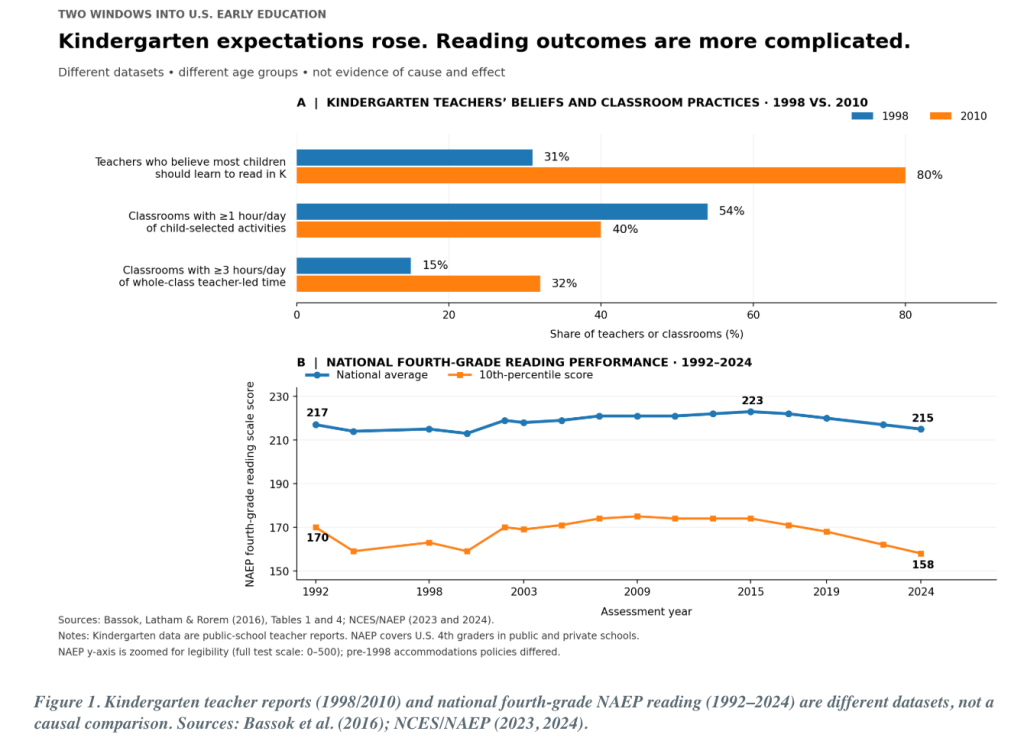
The changes were striking. In 1998, 31% of teachers agreed or strongly agreed that most children should learn to read in kindergarten. By 2010, that figure was 80%. Meanwhile, the share reporting at least an hour of child-selected activities per day fell from 54% to 40%, and the share reporting three or more hours of teacher-directed whole-class activities rose from 15% to 32%.
Those figures are about teachers’ beliefs and classroom routines, not a directly measured national increase in the difficulty of every kindergarten curriculum. Still, they provide concrete evidence of a major shift toward more academic and teacher-directed experiences.
That shift makes me wonder: when the expectations increase, where does the additional time come from? What experiences become more difficult to protect?
What Does the Achievement Data Actually Show?
If students are encountering more academic expectations in their early years, it is reasonable to ask whether national achievement has improved alongside that shift. But the data are not as simple as “more academics equals lower scores.”
The accompanying figure places two separate sources side by side: historical kindergarten teacher reports and National Assessment of Educational Progress (NAEP) fourth-grade reading results. The NAEP trend is not a follow-up of the children in the kindergarten study, and no causal relationship can be inferred between these datasets.
Fourth-grade average reading scores rose at some points between 1992 and 2015, then declined. In 2024, the national average was 215, compared with 220 in 2019 and 217 in 1992. The 2024 result was not statistically distinguishable from the 1992 average. At the lower end of the score distribution, the 10th-percentile score declined from 170 in 1992 to 158 in 2024.
Those results raise serious questions about progress and equity, but they do not demonstrate that kindergarten curriculum changes caused later reading outcomes. Students, schools, policies, demographics, instructional practices, and disruptions such as the pandemic also matter. Even the historical testing conditions changed: NAEP did not permit accommodations in 1992 and 1994.
Still, it is worth asking whether moving faster through more material is always the same as helping children learn more deeply. I don’t believe it is.
And I’m not arguing that young children cannot handle advanced content. Some absolutely can. The issue is whether our systems give each child what they need to understand it.
The Foundations We Cannot Afford to Overlook
Another concern I have developed throughout my teaching career involves the foundational skills children bring into kindergarten.
In recent years, I have worked with children who need substantial support with tasks such as using scissors, managing their belongings, following multiple directions, sustaining attention, or completing simple activities independently. Those are observations from my teaching experience, not evidence that all children across the country are losing these skills.
Nevertheless, the challenges have important consequences in the classroom. When a child struggles to manipulate a pencil, it affects writing. When a child has difficulty remembering directions, independent work becomes more challenging. When students haven’t developed confidence in trying tasks themselves, they may depend on adult assistance even when they are capable of learning to complete the task.
As kindergarten teachers, we explicitly teach these foundational skills while also delivering a demanding academic curriculum within a tightly structured school day.
Maria Montessori’s philosophy continues to guide my response to this challenge. One principle I try to live by is simple: Don’t do for a child what the child can do for themselves.
To me, this does not mean withholding help. It means recognizing when an adult’s well-intentioned assistance might prevent a child from developing a skill independently. Practical-life experiences, fine-motor activities, and opportunities to solve everyday problems are not distractions from academic learning. They help children develop the coordination, concentration, confidence, and independence that support learning.
Bringing Montessori Into a Traditional Classroom
Although I no longer teach at a Montessori school, I have spent the past two years finding ways to incorporate Montessori-inspired materials into my kindergarten classroom.
In literacy, we use sandpaper letters, sound pouches containing objects for initial-sound matching, and the moveable alphabet paired with consonant-vowel-consonant words, pictures, and objects.
In mathematics, I have incorporated sandpaper numbers, cards and counters, small number rods, colored bead bars, bead stairs, teen boards, hundred boards, and decimal system materials that represent ones, tens, hundreds, and thousands.
These materials give children opportunities to physically explore concepts that can otherwise feel abstract. Before expecting students to compare written numbers, for example, I want them to understand what quantities actually represent. They should have opportunities to count, match, arrange, manipulate objects, and discover numerical relationships for themselves.
Our school is not a Montessori school, and I do not have enough materials for every child to work with the same lesson simultaneously. Instead, I incorporate the materials into small-group lessons and mathematics stations, connecting them to the learning objectives in our existing Math in Focus curriculum.
It isn’t a perfect solution to individualized pacing. But it allows me to preserve some of the learning experiences I believe are essential.
A 2025 study following children admitted to public Montessori preschool through randomized admissions lotteries found stronger end-of-kindergarten outcomes in reading and several measures of executive function and memory. The research has limitations, and it does not establish that every student should attend Montessori. But it adds to a growing conversation about learning environments that combine academic content with hands-on materials, independent activity, and sustained attention to development.
Inside My Classroom: One Goal, Different Paths
Here is what this can look like in a non-Montessori kindergarten classroom. Imagine our current math objective is to compare quantities. The whole class shares the learning goal, but children do not all need the same task to make progress toward it.
At a cards-and-counters station, I might begin with a child who is still building one-to-one correspondence. They match a numeral to a small collection of counters, touching or moving each counter as they count. We can stay within one to five, then change the arrangement and ask, “Is it still five? How do you know?” I’m listening for an understanding of quantity rather than simply a memorized counting sequence.
At a number-rods or bead-bar station, children who already recognize small quantities can build two amounts up to ten, line them up, and decide which is more, which is less, or whether they are equal. We might explore how much more, then connect that concrete comparison to numerals or a drawing. Students who need more support can work with smaller quantities; students who are ready can explain the relationship without recounting every object.
At a teen-board station, children who are secure with ten can explore how numbers from eleven to nineteen are made from one ten and additional ones. For some children, that is the next appropriate step; for others, it is not yet. I may also offer decimal-system materials to children who are ready for a more complex place-value extension, rather than making that material the expectation for everyone.
These are illustrative examples of how I use and adapt the materials, not a claim that a formal intervention has been tested or that every station produces a measured gain. Each station still requires modeling, observation, and follow-up. I might jot down whether a student counted each object once, used quantity words accurately, explained a comparison, or showed a stable understanding of ten and some more.
The real point is not that I have found a magic set of manipulatives. It is that one curriculum objective can be approached through multiple concrete experiences, with enough flexibility to respond to the child in front of me. The challenge is protecting the time to do it well.
Observation prompts: One-to-one counting • quantity–numeral match • more/less/equal • explaining a comparison • ten and some more.
When Differentiation Becomes the Teacher’s Responsibility Alone
I have tremendous respect for teachers working within traditional school systems. Differentiation is difficult, thoughtful work. Supporting students with different academic abilities, developmental needs, language backgrounds, and learning differences requires planning, observation, creativity, and constant adjustment.
Yet I often wonder whether we have placed too much responsibility on teachers to compensate for structures that are not designed with this variability in mind.
We tell teachers to individualize instruction, provide interventions, challenge advanced learners, collect assessment data, support social-emotional development, communicate with families, and meet grade-level expectations. All of those responsibilities matter.
But if schools truly value individualized learning, shouldn’t their schedules, staffing, instructional models, and assessment systems make individualized learning more achievable? Rather than continually asking teachers to do more, perhaps we need to reconsider how we organize the work itself.
What Could a More Flexible System Look Like?
I recognize that there is no perfect model for public education. Schools must serve diverse communities, meet shared academic expectations, use public resources responsibly, and provide equitable opportunities for children with different needs.
Still, I don’t believe those challenges mean we should stop questioning the traditional model.
What if elementary schools protected longer, uninterrupted learning blocks so teachers could provide meaningful small-group instruction and independent practice? What if schools experimented with multi-age classrooms or opportunities for teachers to remain with students across multiple years, allowing deeper relationships and continuity?
What if curriculum frameworks established clear, meaningful goals while allowing more flexibility in when students demonstrated mastery? And what if public education offered families greater access to different evidence-informed approaches, including Montessori-inspired and project-based programs?
These approaches require thoughtful implementation, appropriate staffing, and careful attention to equity. School choice should not mean that access to a suitable learning environment depends on family income, transportation, or neighborhood.
I’m not suggesting every school should become Montessori or that all students would benefit from the same model. I’m suggesting that we should be more willing to design schools around children’s varied learning needs rather than continually requiring children and teachers to adapt to relatively inflexible systems.
Rethinking What Educational Success Looks Like
I believe deeply in children’s capabilities.
I have seen preschoolers develop sophisticated academic understanding when they are given the materials, experiences, and time to build it. I’ve also seen older children struggle with foundational concepts because they need more opportunities to develop genuine understanding.
Neither experience has convinced me that children should be pushed harder or that academic expectations should simply be lowered. Instead, they have reinforced my belief that meaningful learning requires understanding the child first.
We should have high expectations for students. We should teach foundational literacy and mathematics intentionally and provide challenging opportunities for children who are ready. But we must also recognize that readiness is not identical for every child, and learning is not always a straight line.
I don’t want a school system that limits children because of their age. I also don’t want one that rushes them forward because of it.
I want an education system that gives children the opportunity to develop strong foundations, build confidence, explore challenging ideas, and experience the joy of genuine understanding. And I want teachers to work within systems that support that mission rather than make it increasingly difficult to accomplish.
We say every child learns differently. Maybe it’s time we started designing our schools as though we truly believe it.
Research & Further Reading
Bassok, D., Latham, S., & Rorem, A. (2016). Is kindergarten the new first grade? AERA Open.
https://doi.org/10.1177/2332858415616358
National Center for Education Statistics. (2023). Reading performance, The Condition of Education.
https://nces.ed.gov/programs/coe/pdf/2023/cnb_508.pdf
National Center for Education Statistics. (2025). 2024 NAEP reading: National trends and student skills.
https://www.nationsreportcard.gov/reports/reading/2024/g4_8/national-trends/?grade=4
Lillard, A. S., et al. (2025). A national randomized controlled trial of the impact of public Montessori preschool at the end of kindergarten. PNAS.
https://pmc.ncbi.nlm.nih.gov/articles/PMC12582262/
National Association for the Education of Young Children. Developmentally appropriate practice.
https://www.naeyc.org/resources/position-statements/dap/contents


Leave a Reply